


IN BRIEF
- Multiple commercial ships in the Black Sea have reportedly been struck by drones in recent days.
- Experts say the incidents represent a significant broadening of the conflict across the Black Sea.
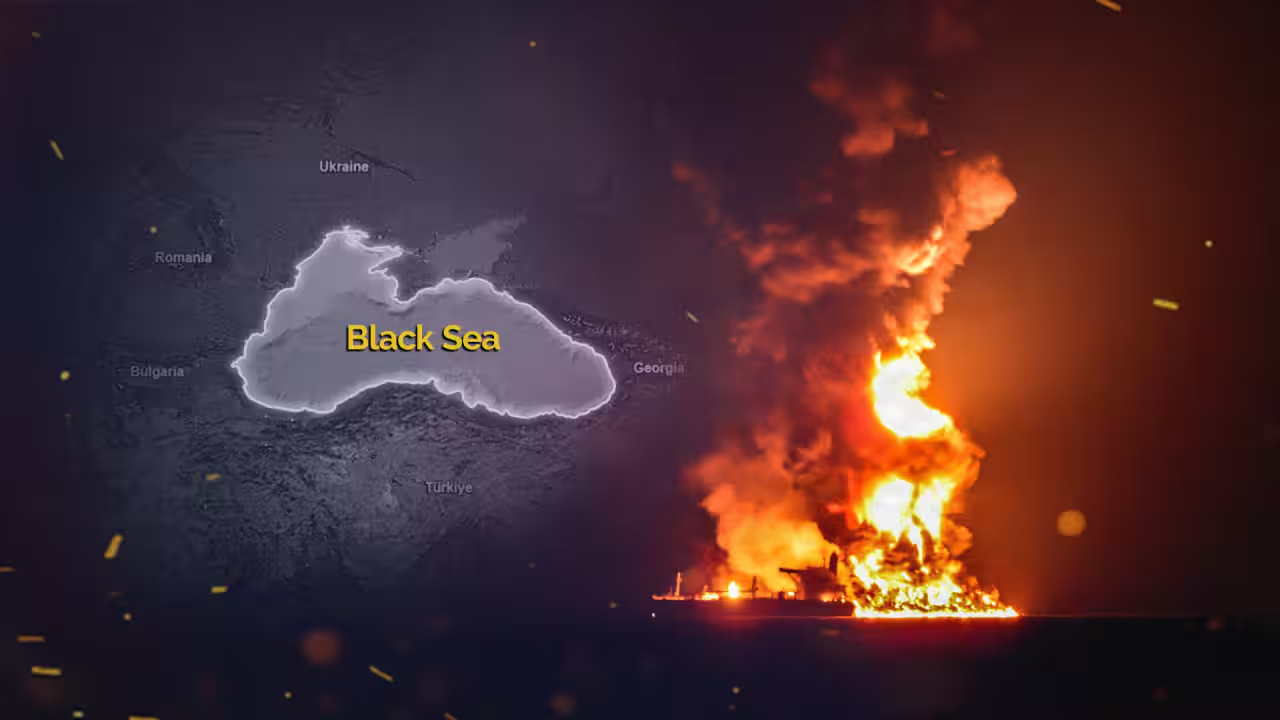
Tensions in the Black Sea are at their highest since Russia’s full-scale invasion of Ukraine in early 2022, experts say, following four attacks on ships in recent days.
The eastern European shipping channel has long been a front in the war, but tensions have now spread west toward two North Atlantic Treaty Organization (NATO) member states.
Earlier this week, a Turkish cargo ship carrying Ukrainian corn caught fire and sank just outside Romania’s territorial waters, leading to the deaths of two people.
Romanian authorities have said the cause of the fire was aerial and sea drones, but are yet to name a suspect for the attack.
Then, two other commercial ships were reportedly struck by drones about 130km off Bulgaria’s coastline.
Your trusted source for staying up-to-date with the world around you. Get free daily news updates and analysis, straight to your inbox.
One ship was damaged and the other sunk, with no “traces” of at least 12 crew members from the sunk ship, according to vice-admiral Rumen Nikolov of Bulgaria’s Maritime Administration Executive Agency.
“If we look at the nature of the cargo and the direction in which the ships were moving, then logically speaking, the result argues in favour of Russia,” Bulgarian Prime Minister Rumen Radev said on Wednesday.
“But that does not mean that we can claim that the strike was carried out by Russia without having evidence.”
In a statement sent to local media on Wednesday, the Russian Embassy in Bulgaria rejected Russian involvement in the drone attacks on the two ships, saying “they were not among the targets hit by Russian armed forces”.
Ukrainian President Volodymyr Zelenskyy, meanwhile, has blamed all three attacks on Russia, saying that they were “part of Russia’s effort to make the western Black Sea completely unfit for navigation”.
Most recently, the Russian transport ministry announced that an oil tanker in the eastern Black Sea, near the resort city of Sochi, was subjected to an attack carried out by unmanned Ukrainian naval vessels.
Ukraine is yet to directly comment on the allegation, but Zelenskyy recently said his country had launched “a response in the Black Sea”, without providing further details.
‘Maximum escalation campaign’
Mick Ryan, a retired Australian Army major general and senior fellow for military studies at the Lowy Institute, said Russia was “undoubtedly” behind the incidents near Bulgaria and Romania.
“The Russians want to strangle Ukraine and destroy it as a sovereign entity, and this is part of their economic warfare … It’s part of their maximum escalation campaign,” he told SBS News.
“The reality is, Putin is desperate. This war has gone longer than he thought. It’s killed far more of his people than he ever expected, and he has almost nothing to show for it.”
Russia has targeted vessels in the region since 2022, including ships carrying agricultural products like corn.
Ukraine has also launched attacks on Russia’s so-called shadow fleet — used to bypass international sanctions on Russian exports such as oil and gas — and its Black Sea naval fleet.
“The vessels that the Ukrainians are attacking are sanctioned under international law and are transporting goods illegally. What Ukraine is doing is the legal export of grain to nations where people are hungry,” Ryan said.
“There’s no intellectual or moral equivalence between these two campaigns.”
‘Broadening across the Black Sea’
Although the Black Sea has been an established battleground, experts say tensions there have escalated in the past year, with more areas, locations, and now civilians being potentially targeted.
Jennifer Parker, an adjunct professor at the University of Western Australia’s Defence and Security Institute, said in 2026 there has been “an intensification of attacks on civilian shipping in the Black Sea”.
“If these ships were not carrying military equipment or making a military contribution to the conflict, then they are civilian objects, and they’re not a lawful target,” she said.
“If you step away from the law of it, what it shows is that Russia is increasingly brazen in terms of where they are willing to attack civilian ships.”
The incidents off Bulgaria and Romania all occurred outside the countries’ territorial waters but within their exclusive economic zones (EEZs) — areas in which nations have sovereign rights to explore, exploit, conserve, and manage marine and mineral resources.
Maritime security firm MARISKS has also raised concern about “the apparent geographic expansion of incidents beyond waters immediately adjacent to Ukraine and into the EEZs of NATO members Romania and Bulgaria”.
Parker warned that the significance of the recent incidents is that “the attacks are broadening across the Black Sea”.
“What’s unique about the vessel attack off Bulgaria is their location, so much further west in the Black Sea than [what] we’ve seen,” she said.
“If you think about the hybrid attacks or the interference that’s been occurring across Europe that has been attributed to Russia, this also serves as a reminder to members of NATO, which of course Bulgaria is, that Russia is broadening the conflict.”
A ‘war with NATO’
After the recent attacks, Radev has warned that if the war does not end in time, “it will continue to expand its geographical scope and increase the risk of even a global conflict”.
On Monday, the European Union’s foreign policy chief Kaja Kallas said the continent has seen a “spike in the Russian hybrid attacks and sabotage attempts and airspace violations in recent weeks”.
In one of the latest similar incidents, in Moldova on Ukraine’s western border, the defence ministry said three drones crossed into its airspace. Earlier in August, multiple drone incidents, allegedly linked to Russia, were reported at Leipzig airport in Germany.
“If these attacks on these two ships … are read in the context of that, then I think that, of course, there is a broadening of the war and genuine concern,” Parker said.
“By themselves, do they constitute a significant broadening of the conflict? Not necessarily.”
Ryan said that while Russia was increasingly provoking NATO member states, the alliance’s response has been mild.
“We should understand here, Putin has said constantly and is acting like he is at war with NATO. We have to listen to that,” he said.
Ryan said that unless NATO comes down hard, “I think Putin will continue with these kinds of attacks, whether it’s in the Black Sea or across continental Europe.”
— with additional reporting from the Reuters news agency and the Associated Press.
For the latest from SBS News, download our app and subscribe to our newsletter.
Discover more from BrandedNepal | Shop Nepal’s Best Local & Global Brands
Subscribe to get the latest posts sent to your email.
