

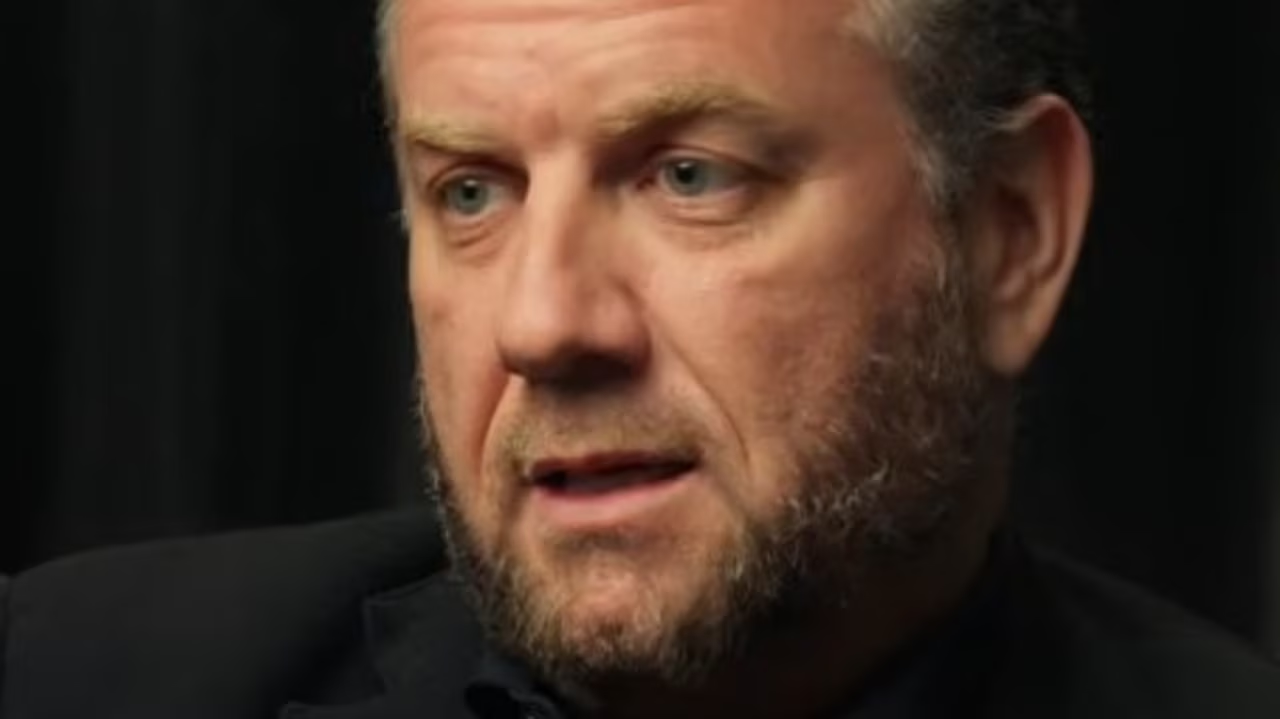

In a direct affront to the government’s claims the war in the Middle East is the biggest cause of surging inflation hurting everyday Aussies, one of Australia’s leading economists says the nation’s problems run much deeper.
In an hour-long interview on Mark Bouris’s Straight Talk podcast, Coolabah Capital founder and portfolio manager Chris Joye warned of a painful looming recession and of house prices in some areas falling as much as 40 per cent.
MORE: The Aussie suburbs where house prices are falling
He accused Federal Treasurer Jim Chalmers of “bulls**ting” over inflation, adding that an out-of-touch political class was the biggest reason the country was in a rut.
“All of our inflation, most of it, is driven by the professional politicians. It’s the fact that they’ve racked up $660 billion of debt and spending since 2022 alone across federal and state governments,” he said.
“Our annual interest bill, mate, has gone from $5 billion a year to basically if you take that $2 trillion in a few years and you assume it all gets refinanced at current interest rates, which is pretty likely, we will be paying about $110 billion a year in interest. That’s 10 per cent of our current federal debt.
MORE: 80s Aus home prices expose Boomer lie
“That’s 24 hospitals, mega hospitals a year in interest. And it’s all public spending. It’s all population growth and migration. And it’s all productivity. I mean, the oil price stuff is at the margins. It’s not it’s not the reason the RBA hasn’t hit its inflation target since 2021. That’s a recent event. So, he’s just bulls****ing.”
He warned that with government spending remaining unchecked and immigration placing strain on services, the nation is sleepwalking straight into a brutal recession, record business insolvencies, and the steepest housing market decline in modern history.
Economist warns of Canberra ‘oligarchy’
During the wide-ranging interview, Bouris pressed Mr Joye on why everyday Australians are copping the brunt of soaring interest rates while government continues to spend heavily.
Mr Joye argued federal and state governments became drunk on ultra-cheap cash when sovereign bond yields touched historic lows of 0.6 per cent in 2020. That prompted what he termed the “Dan Andrews effect”, where politicians assumed borrowing was permanently free and racked up massive debts to fund pet projects.
He said the nation’s capital was an insulated bubble that was out of touch with how everyday Aussies were faring.
“It’s an oligarchy. Canberra is an oligarchy,” Mr Joye said. “These guys have never started a business, launched a product or service, or hired a single soul. They just don’t get it. They see us as high-value targets in a zero-sum game: take from the private sector in order to power the public sector. As Milton Friedman (a Nobel prize-winning US economist) said many times, consumers never create inflation. Governments do.”
‘Sales haven’t just dropped, they’ve stopped’
One of the biggest pain points for Australia, according to Mr Joye, is the housing market, which is taking a historic hammering as the Reserve Bank of Australia is forced to keep tightening monetary policy to combat inflation.
Mr Joye revealed that property prices across the nation are already plunging at an annualised pace of 16 per cent, with Sydney deteriorating even faster at an 18 per cent annual rate.
“Our forecasts currently have the peak-to-trough fall in Sydney prices at 17 per cent,” Mr Joye said. “But here’s the rub, mate. That’s the $5 million per-person city average. Within the city, on our numbers, individual suburbs will fall as much as 20 to 40 per cent. We’ll break the record for the biggest fall ever in house prices on our numbers before Christmas.”
Bouris, executive chairman of Yellow Brick Road, said he had heard residential development was in crisis across the nation, which Mr Joye agreed with.
“You know this better than me, but I’ve spoken to two big residential developers during the week,” Mr Joye said. “They’ve said sales aren’t down, mate. Sales have freaking stopped. They don’t exist.”
He also pointed to a severe squeeze in non-bank lending and private credit, which had aggressively funded developers who were shut out of the major banks. With delinquencies rising and wholesale investors pulling their money, the market is facing a crunch akin to the 1991 downturn.
$150 billion idea to fix nation’s finances
When Bouris challenged Mr Joye on how he would fix the economic mess if handed the keys to the Treasury, the economist put forward a radical rescue package.
At the centre of Mr Joye’s strategy is an unprecedented raid on government piggybanks: clawing back $150 billion from the Future Fund and quarantined special interest vehicles to pay off national debt immediately.
Mr Joye argued that the $350 billion Future Fund, originally set aside to cover the superannuation liabilities of retired public servants and politicians, holds between $60 billion and $100 billion more than required due to compounding 9 per cent annual returns against its original 7 per cent mandate. On top of that, Mr Joye highlighted another $66 billion parked in side funds for housing, disaster relief, and medical research.
“Of that $66 billion, $30 billion is actually sitting in cash deposits earning about 4 per cent, whereas the government is paying interest on debt of 5.5 per cent,” Mr Joye said. “We’re losing money on that cash. It’s negative carry. If you or I did that in a fund, they’d be talking about it forever.”
By taking $150 billion out of these funds and retiring sovereign debt, the government would immediately wipe out roughly 10 to 12 per cent of its liabilities and save $8 billion every single year in interest payments.
Aside from debt repayment, Mr Joye called for a brutal slashing of government spending.
He said that if he were Treasurer, he would sack 25 per cent of the federal public service to address private sector labour shortages, privatise the National Broadband Network for $20 billion to $30 billion, cut the National Disability Insurance Scheme by 75 per cent to roughly $25 billion annually, slash personal and company income taxes, lift the GST to 15 per cent, and hit pause on immigration to allow housing and infrastructure to catch up.
Economist meets with Pauline Hanson
With faith in the major parties cratering under the weight of the cost-of-living crisis, Mr Joye revealed he recently held a confidential economic briefing with One Nation leader Pauline Hanson and her senior team.
“Pauline Hanson’s chief of staff reached out to me, and I actually met with them both during the week,” Mr Joye revealed to an intrigued Bouris. “I was really surprised. I wasn’t expecting Pauline Hanson to be the very analytical and interesting mind that she presented. Even numerically, she was kind of running debt servicing calculations in her head.”
He said Hanson had quietly assembled a formidable backroom policy team, including a former general counsel to Scott Morrison and a top-tier corporate lawyer.
“When I started giving my economic view of the world, you can usually see when politicians get that glazed-eye look and just nod without understanding,” Mr Joye said. “Whereas she was fully intellectually engaged. The best politicians are folks who are constantly engaged, constantly listening, and able to make good decisions under duress.”
The looming ‘recession we had to have’
As ominous signs appear in the economy, Mr Joye painted a bleak picture of the years ahead, comparing the current artificial intelligence boom to the late 1990s dot-com bubble.
He pointed out that US stock valuations on cyclically adjusted price-to-earnings metrics have reached 41 times earnings, a level eclipsed only once in 200 years, right before the tech bust in 2000 that saw the Nasdaq shed 78 per cent.
He argued that unlike previous technological shifts that lowered prices, the AI build-out is actively fuelling inflation by driving unprecedented demand for energy, chips, and capital expenditure.
He also slammed central banks for chasing a mythical “narrow path” to bring down inflation without triggering job losses, stating that Reserve Bank Governor Michele Bullock has finally been forced to confront reality.
“The RBA has now capitulated,” Mr Joye said. “Bullock has retired the narrow path idea. They’re now in the demand destruction game, which basically means kill growth, raise unemployment to create capacity, and push capital from bad businesses to good businesses.”
Mr Joye predicted Australia’s official jobless rate would have to climb from 4.6 per cent to well above 5 or 6 per cent to purge inflation from the system.
“Australia gets a recession, but it’s probably the recession we had to have because we need a cathartic crisis,” Mr Joye said. “Your house is not going to be worth as much as it was, your super is probably not going to be worth as much as you thought, and you’re going to have to work a little longer. It is going to be very tough.”
You can watch the full interview on YouTube
Discover more from BrandedNepal | Shop Nepal’s Best Local & Global Brands
Subscribe to get the latest posts sent to your email.

