
WARNING: This article may affect those who have experienced sexual violence or know someone affected by it.
Harvey Weinstein’s rape retrial ended in a mistrial Friday after the jury deadlocked in the closely watched #MeToo-era case that another jury failed to decide last year.
While the former Hollywood mogul has been convicted of other sex crimes on two U.S. coasts and remains behind bars, the mistrial leaves the New York rape charge in limbo after three trials.
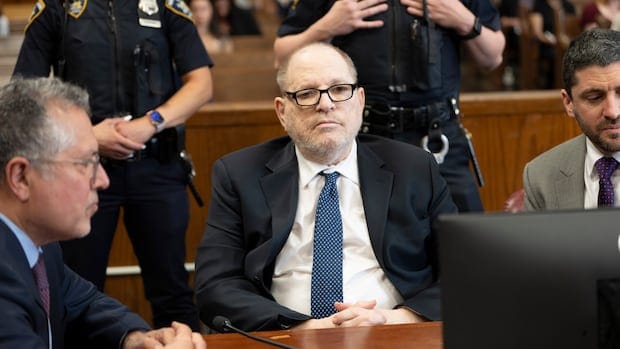
Weinstein appeared expressionless as court officers ushered him out in his wheelchair.
A majority-male Manhattan jury had been weighing whether Weinstein raped Jessica Mann, a hairstylist and actor. Weinstein’s lawyers argued that the encounter was consensual. It happened in 2013 during a fraught relationship between the then-married Weinstein and the decades-younger Mann.
The signs of stalemate emerged Friday a few hours into the third day of deliberations. Jurors sent a note saying they “have concluded that they cannot reach” a unanimous verdict. Judge Curtis Farber instructed the group to continue deliberating. That’s generally what New York judges do at least the first time a jury says it’s stuck.
Jurors returned to their closed-door discussions for more than an hour before sending another note with the same message, adding: “We feel that no one is going to change where they stand.”
One juror, Josh Hadar, told reporters that nine people wanted to acquit Weinstein and three wanted to convict him.
Defence attorney Marc Agnifilo called it “a great day for our jury system.”
No immediate decision about 4th trial
A hearing was set for June 24 to learn whether prosecutors will choose to go to a fourth trial. District Attorney Alvin Bragg said he was disappointed with the result but “we deeply respect the jury system.”
Bragg said his staff will consult Mann about another trial and also take into account what happens to Weinstein when he’s sentenced in another case. Mann was not in court when the mistrial was declared.
As an Oscar-winning movie producer and studio boss, Weinstein was one of Hollywood’s most powerful figures and a significant Democratic donor before long-suppressed sexual harassment and sexual assault allegations against him cascaded into public view in 2017.
The revelations galvanized the #MeToo movement’s demands for accountability for sexual misconduct, made Weinstein a pariah, bankrupted the studio and ultimately led to criminal charges against him in New York and Los Angeles.
He was convicted of some and acquitted of others. Yet Mann’s allegation lingered. Weinstein was convicted of the charge in 2020. Then an appeals court overturned that verdict, and jury deliberations broke down at a 2025 retrial. That paved the way for this year’s retrial.
‘I tried to leave’
Weinstein has said he was unfaithful to his then-wife and “acted wrongly, but I never assaulted anyone.”
Mann, now 40, met Weinstein at a Los Angeles party in early 2013, when she hoped to build a handful of acting credits into a big career.
She said his initial, pushy overtures discomfited her, but she acceded to them and decided to develop a relationship with him.
She was staying with a friend at a Manhattan hotel in March 2013 when Weinstein showed up early for a planned breakfast and got a room over her objections, Mann testified. She said she accompanied Weinstein to the room to talk and made it clear she didn’t want sex.
“I said ‘no,’ over and over, and I tried to leave,” she told jurors during five days of intense testimony.
She said that Weinstein blocked her from leaving and grabbed her arms. Scared, she gave up protesting, complied with his demands to undress, and laid on a bed while he went into a bathroom, she told jurors. Then, Mann said, he raped her.

New York’s highest court has overturned Harvey Weinstein’s 2020 conviction for sexual assault and rape, a landmark ruling of the #MeToo movement. Andrew Chang explains how the prosecution knew it was taking a gamble, and where that gamble went wrong.
She told no one for years
Mann told no one for years about the alleged rape. Nor did she mention it in her introspective, private writing two days later. In a note to herself, she grappled with conflicted feelings about becoming “emotionally attached” in a nonexclusive relationship with a man she didn’t name.
After Weinstein’s new lawyers confronted Mann with the note, she said she hadn’t needed to write down the allegation.
Weinstein didn’t testify. In his lawyers’ telling, Mann was a willing partner in a close, supportive relationship with a show-business insider who opened doors for her, but she turned on him once he became an outcast.
In the months and years after the New York encounter, Mann kept seeing and communicating with Weinstein.
At times, she pulled away to pursue and preserve a relationship with a new boyfriend, according to her emails and testimony. At other times, she turned back to Weinstein, who validated her acting dreams, told her he was proud of her and responded caringly when her father was terminally ill.
“I love u. Anything u need,” Weinstein wrote.
#MeToo reports prompted her to go to police
Over the years, he helped Mann land a movie audition and a hairstyling job. She asked him for help with such things as a car problem and a club membership, though she declined a package his office tried to send in summer 2013, when she couldn’t make rent. Mann said she understood the envelope contained $1,000 US in cash.
In one of her last emails to Weinstein, in February 2017, she wrote: “I love you, always do. But I hate feeling like a booty call.” When he responded by suggesting she was “joking” and should stop using his company email, she said it was a joke and apologized.

Eight months later, she saw the news reports that propelled his downfall and ultimately prompted her to go to police.
Mann never sued Weinstein, but after his 2020 conviction, she filed for and got about $500,000 US from a sexual misconduct settlement fund set up during his company’s bankruptcy. The payout was mentioned at last year’s retrial, but the defence didn’t raise it this time after extensive arguments about what could and couldn’t be said.
The Associated Press generally does not identify people who say they have been sexually assaulted. Mann, however, has agreed to be named.
If you’re in immediate danger or fear for your safety or that of others around you, please call 911. For support in your area, you can look for crisis lines and local services via the Ending Sexual Violence Association of Canada database.